• Archives

  • Topics

  • Meta

  • The Boogeyman - Working Vacation
  • Coming Home
  • Via Serica

A Year of Poetry – Day 353

The time I’ve lost in wooing,
In watching and pursuing
The light, that lies
In woman’s eyes,
Has been my heart’s undoing.
Though Wisdom oft has sought me,
I scorn’d the lore she brought me,
My only books
Were woman’s looks,
And folly’s all they’ve taught me.

Her smile when Beauty granted,
I hung with gaze enchanted,
Like him the Sprite,
Whom maids by night
Oft meet in glen that’s haunted.
Like him, too, Beauty won me,
But while her eyes were on me,
If once their ray
Was turn’d away,
Oh! winds could not outrun me.

And are those follies going?
And is my proud heart growing
Too cold or wise
For brilliant eyes
Again to set it glowing?
No, vain, alas! th’ endeavour
From bonds so sweet to sever;
Poor Wisdom’s chance
Against a glance
Is now as weak as ever.

— Thomas Moore, The Time I’ve Lost in Wooing

A Year of Poetry – Day 352

Liza, go steep your long white hands
In the cool waters of that spring
Which bubbles up through shiny sands
The colour of a wild-dove’s wing.

Dabble your hands, and steep them well
Until those nails are pearly white
Now rosier than a laurel bell;
Then come to me at candlelight.

Lay your cold hands across my brows,
And I shall sleep, and I shall dream
Of silver-pointed willow boughs
Dipping their fingers in a stream.

— Elinor Wylie, Spring Pastoral

Musings

  • I’d like to send a shout-out to the Kentucky Transportation Cabinet, who has been working hard on the roads hereabouts lately.
    • It takes real talent to make a road worse after the repair.
    • Here’s a hint – If the only notification that your road crew is removing barrels after dark is when my headlights hit their reflective vests, you’re doing it wrong.
    • Yes, I was doing the speed limit, and there were “ROAD CREW” signs posted. I got over onto the shoulder a bit to give them room once I knew they were there, but lights are cheap and road workers are worth the expense.
  • A rural SUPERDUPERMART on a Sunday night is a real cultural experience.
    • There was a lot of mutton dressed up as lamb, a lot of lamb dressed up as breeding ewe, and a few rams dressed up as… well, not as rams.
    • Folks from all over the hemisphere, of all ages, seem to congregate there to mix and mingle.
    • I must be weird for needing an ironing board.  I got more looks than the older woman who was wearing clothing five sizes too small.
  • There was a strange point during my drive tonight where a rock station faded out somewhat, a country station faded in a bit, and they both mixed in with a Spanish station on the same frequency.
    • The condition only lasted for a few minutes.  I was hoping to hear some station identifiers so I try to figure what kind of weird hop would cause that.
  • I have done my yearly mowing of the lawn.  I do not plan on doing it again until this time next year.
    • The act of clipping the top six or seven inches off of a perfectly good blade of grass is alien to me.

A Year of Poetry – Day 351

I once had a sweet little doll, dears,
The prettiest doll in the world;
Her cheeks were so red and so white, dears,
And her hair was so charmingly curled.
But I lost my poor little doll, dears,
As I played in the heath one day;
And I cried for more than a week, dears,
But I never could find where she lay.

I found my poor little doll, dears,
As I played in the heath one day:
Folks say she is terribly changed, dears,
For her paint is all washed away,
And her arms trodden off by the cows, dears
And her hair not the least bit curled:
Yet for old sakes’ sake she is still, dears,
The prettiest doll in the world.

— Charles Kingsley, My Little Doll

A Year of Poetry – Day 350

Come where the white waves dance along the shore
Of some lone isle, lost in the unknown seas;
Whose golden sands by mortal foot before
Were never printed,—where the fragrant breeze,
That never swept o’er land or flood that man
Could call his own, th’ unearthly breeze shall fan
Our mingled tresses with its odorous sighs;
Where the eternal heaven’s blue sunny eyes
Did ne’er look down on human shapes of earth,
Or aught of mortal mould and death-doomed birth:
Come there with me; and when we are alone
In that enchanted desert, where the tone
Of earthly voice, or language, yet did ne’er
With its strange music startle the still air,
When clasped in thy upholding arms I stand,
Upon that bright world’s coral-cradled strand,
When I can hide my face upon thy breast,
While thy heart answers mine together pressed,
Then fold me closer, bend thy head above me,
Listen—and I will thee how I love thee.

— Frances Anne Kembel, An Invitation

A Year of Poetry – Day 349

It was an April morning: fresh and clear
The Rivulet, delighting in its strength,
Ran with a young man’s speed; and yet the voice
Of waters which the winter had supplied
Was softened down into a vernal tone.
The spirit of enjoyment and desire,
And hopes and wishes, from all living things
Went circling, like a multitude of sounds.
The budding groves seemed eager to urge on
The steps of June; as if their various hues
Were only hindrances that stood between
Them and their object: but, meanwhile, prevailed
Such an entire contentment in the air
That every naked ash, and tardy tree
Yet leafless, showed as if the countenance
With which it looked on this delightful day
Were native to the summer.–Up the brook
I roamed in the confusion of my heart,
Alive to all things and forgetting all.
At length I to a sudden turning came
In this continuous glen, where down a rock
The Stream, so ardent in its course before,
Sent forth such sallies of glad sound, that all
Which I till then had heard, appeared the voice
Of common pleasure: beast and bird, the lamb,
The shepherd’s dog, the linnet and the thrush
Vied with this waterfall, and made a song,
Which, while I listened, seemed like the wild growth
Or like some natural produce of the air,
That could not cease to be. Green leaves were here;
But ’twas the foliage of the rocks–the birch,
The yew, the holly, and the bright green thorn,
With hanging islands of resplendent furze:
And, on a summit, distant a short space,
By any who should look beyond the dell,
A single mountain-cottage might be seen.
I gazed and gazed, and to myself I said,
‘Our thoughts at least are ours; and this wild nook,
My EMMA, I will dedicate to thee.’
—-Soon did the spot become my other home,
My dwelling, and my out-of-doors abode.
And, of the Shepherds who have seen me there,
To whom I sometimes in our idle talk
Have told this fancy, two or three, perhaps,
Years after we are gone and in our graves,
When they have cause to speak of this wild place,
May call it by the name of EMMA’S DELL.

— William Wordsworth, It Was An April Morning:  Fresh and Clear

100 Years On – Lafayette, We Are Here!

On April 6, 1917, the Congress of the United States declared war against Germany.  President Wilson had asked for the declaration on April 2, and had said that he wished to wage war to “make the world safe for democracy.”

The first small American units arrived in France in June 1917, and were in combat in October of that year.  Eventually, the American Expeditionary Force numbered approximately 2 million men, with the total number of Americans drafted into service coming to 2.8 million.  By the time of the Armistice in 1917, the United States had lost 116,516 men, with 204,002 wounded and 3,350 missing.

American entry into the First World War brought about revolutionary changes not only in training, organization, and command of the American military, but also in the relationship between the American citizen and their government.  Massive propaganda programs, ranging from speeches to pamphlets, to suppression of anti-war sympathizers were instituted in a systematic, nationwide program.

For the first time, the law was used against citizens who disagreed.  The Espionage Act of 1917, passed in June of that year, made it a crime to hinder the war effort or to give moral and material support to the Germans.  It was amended in 1918 to make it a crime to criticize the government, the conduct of the war, or the military.  In 1919, the Supreme Court found that the act, including the amendments that curtailed speech against the government, was constitutional.  Although many of the 1918 amendments were repealed.

The AEF bolstered Allied forces, even though their arrival into the front line was delayed until they were properly trained and could enter combat as discreet units.  General Pershing, their commander, had clashed with his counterparts in the British and French armies, who wished to intermix American units and individual soldiers with their formations. Pershing insisted on American control of American soldiers, a tradition that has persisted to this day.

American units would provide needed manpower in the battles to come in 1917 and 1918.


A Year of Poetry – Day 348

What sight so lured him thro’ the fields he knew
As where earth’s green stole into heaven’s own hue,
Far-far-away?

What sound was dearest in his native dells?
The mellow lin-lan-lone of evening bells
Far-far-away.

What vague world-whisper, mystic pain or joy,
Thro’ those three words would haunt him when a boy,
Far-far-away?

A whisper from his dawn of life? a breath
From some fair dawn beyond the doors of death
Far-far-away?

Far, far, how far? from o’er the gates of birth,
The faint horizons, all the bounds of earth,
Far-far-away?

What charm in words, a charm no words could give?
O dying words, can Music make you live
Far-far-away?

— Alfred, Lord Tennyson, Far-Far-Away

Second Wash on Cover Art

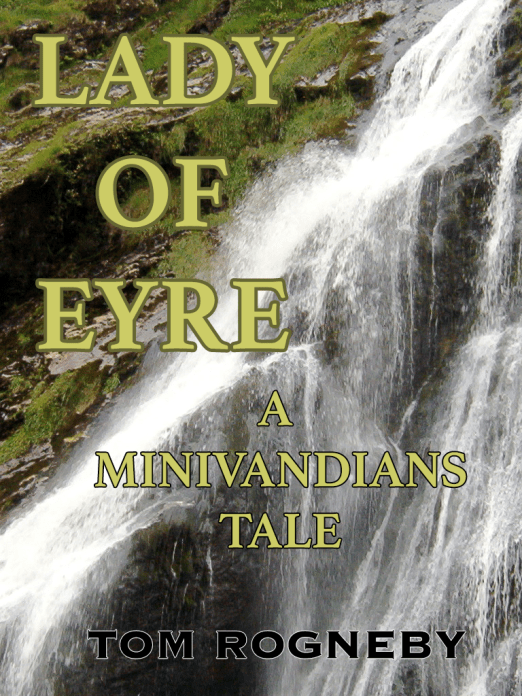
OK, after many excellent suggestions both here, on other media, and in meatspace (Irish Woman leaning over my chair and pointing at my screen), I think this is how the cover art for Lady of Eyre will end up:

Lady of Eyre Ebook Cover5.png

You can read the text against both the light and dark, everything comes out in a thumbnail, and it’s not just black and silver text against a multi-colored background.

Thanks for all the suggestions, everyone!

Lady of Eyre Cover Image

The third installment of the latest Minivandians arc, Lady of Eyre, is nearing completion.  I hope to have it out to you all in a couple of weeks.

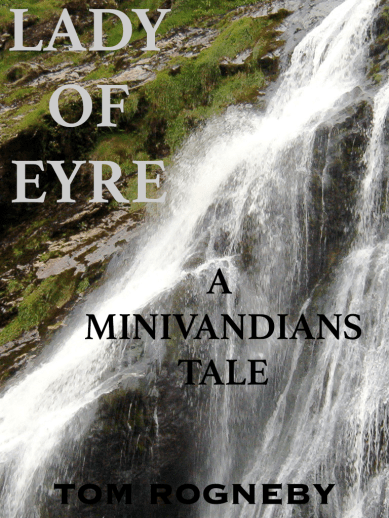
Here’s a quick look at the cover image for the ebook

Lady of Eyre Ebook Cover

This is taken from a picture Irish Woman took when we visited Ireland a few years ago.  Please let me know what you think.

Work continues on the additional material I’ll be adding to the compilation of Quest to the North, Lost Children, and Lady of Eyre, and my plan is to have that out around the beginning of June.