• Archives

  • Topics

  • Meta

  • The Boogeyman - Working Vacation
  • Coming Home
  • Quest To the North
  • Via Serica
  • Tales of the Minivandians
  • Join the NRA

    Join the NRA!

Snippet

Here’s another bit from a short story in the upcoming collection.


December 31, 11:55 PM Eastern
Louisville, Kentucky

Jeanine stirred the coals with a poker, then put a large log into the fireplace. Behind her, she could hear Jim switching the television back and forth between New Year’s Eve programs. One showed one of the latest pop tarts squeaking her way through a forty-year-old folk song, while the other had a band, which was old enough to have played that song at their first rehearsal, grinding their way through a big band tune. Neither seemed to be keeping her husband’s interest.

As she turned back toward the family room, he settled on one of the news stations. It showed a long pan of Times Square, which would normally have been wall to wall with revelers braving the cold to ring in the New Year. Tonight, however, only the stage had a crowd around it, and even that was sparse. When the camera panned around the brightly-lit square, Jeanine saw two lines of police in armor and helmets, as well as several dark-painted armored cars, arrayed around the crowd.

“Think something will happen?” she asked as she sat down in her chair and picked up her drink. On the TV screen, a police helicopter flew noisily over the top of the stage. The singer did not miss a beat, however, and continued to hop around and mouth the words to her song.

Jim shrugged. He had been quiet all evening, yet seemed restless as he played cards with Jordan before putting him to bed.

“Don’t know,” he said, ice ringing against the side of the glass as he lifted his bourbon from the table, “Wouldn’t surprise me.”

His wife reached over and caressed his shoulder. “What’s wrong?” she asked.

“Went by the recruiter’s office yesterday,” he replied.

What?” Jeanine sputtered.

“We’ve talked about this,” Jim said, “I’ve been thinking of joining the Guard for a while, and you said it sounded like a good idea.”

“So you’re joining the National Guard?” she answered.

“No, I was talking to the active duty recruiter,” he replied, finally taking his eyes off the TV and facing his wife.

You what!” she exclaimed.

Jim shrugged. “I wasn’t going to sign up without talking to you,” he said, “I just wanted to see what I could do.”

“And?” she demanded.

“There’s not much need for a middle-aged fobbit,” he replied, “Even when I showed them my DD-214 and degree, they didn’t have anything for me.”

Jeanine relaxed a bit. She had tried to read Jim’s discharge papers, and the laundry list of assignments and training had made her eyes cross. If the recruiter had turned him down with all that, then he would not be going anywhere.

“Honey, I know you want to do something…” she said.

“Other than sitting here on my ass and pushing electrons around at work?” he said darkly as the image on the TV changed to the crystal ball at the top of a tower in Times Square.

“Baby, we need you here,” she said, “I need you.”

“Line was out the door,” Jim said, looking down at his tumbler, “Everything from high school kids to a couple of Vietnam pilots trying to sign up. Recruiter said it had been like that for days, and even the ones they can take are on a waiting list.”

Jeanine sat silent for a moment as the brightly-lit ball on the TV screen started its descent.

“What are you going to do?” she asked quietly.

“I’ll figure something out,” Jim replied as the crowd on the TV counted backward to zero.

Jeanine got up from her chair and sat down on her husband’s lap. Putting her arms around his neck, she held his head close to her and kissed him tenderly.

“Happy New Year, sweetheart,” she said, “and thank you for being here for us.”

Snippet

This is from a short story in the Minivandians universe that will be in the upcoming collection.

Escort Duty

Tor Dveglammar listened as the captain of his cavalry completed the morning report.

“… over the mountain.  We expect them to report back in two days, maybe three.  There’s been no sign of the enemy other than isolated groups of stragglers since they ran from their lines near Tanahuk three days ago,” the young officer said, pointing to a map tacked to the tent wall, “so their main body must have escaped through one of the passes.”

Tor nodded as he stroked the long braids in his russet beard. His wife had kept him in their tent until she had them perfect, but his habit of pulling on them when he was frustrated had already pulled several whiskers loose.

“Dat makes sense,” he said in a low, tense voice, “Report vat da scouts find as soon as dey get back.”

“Yes, my lord,” the captain said, bowing.  Tor returned the salute, and the cavalryman turned and left the tent.   Tor’s aide, Soren, poked his head in the tent flap.

“Anyting else?” Dveglammar growled.  His army had been sitting on its ass for a week after shattering their foe, and their commander was growing restless.  His aide, who also happened to be his wife’s cousin, was lucky to have a thick skin after the first few days of rest and idleness had worn thin.

“Two things, sir.  There’s the matter of Princess Erica, and we have to deal with that man we caught stealing from the plunder.”

“Oh, ja, dat.  All right, bring in da prinzess.  I still don’t know vat to do vit dat damned half-elf.”

Soren nodded and left his commander behind to brood.  Tor’s eyes flicked to the steel rings of his armor, which rested on a table in the corner with the warhammers that gave him his name.

Dose tings are gettin’ dusty, he thought bitterly, Need to get dem back in da field.

With a sigh, he rose and paced the ground behind his chair.  He was a campaigner, not a general, but when the counter-attack at Tanahuk had killed Baron Karl, the responsibility had fallen to him.  The martial duties, those he had known what to do with.  The rest?

“Bah!” he exclaimed to the empty tent.  He considered whether or not it was worth walking outside to enjoy some of the spring sunshine, but the tent flap pulled back and Princess Erica, daughter and only child of Baron Karl Lowenherz, ruler of the Western Islands, flounced in.  A small girl, wearing a shift and wimple that matched her brown hair, walked behind her, holding the back of the princess’ skirt up from the grass and dirt.  

Erica wore what could charitably be called armor and a helmet over her satin gown.  The silvered iron wings that adorned her head covering, polished to a mirror finish, glinted in the beam of sunlight that followed her through the door.  Her bodice of silver ringlets, sewn onto pale blue leather, accentuated the creamy white undergarment that lay between it and her milky skin.  Overall, when combined with her sharp features and ice blue eyes, she looked every inch of a shield-maiden.

Tor tried hard to not snort when she strutted up to him and stood at attention.  He’d seen her fence with her father’s guard, and she had talent.  But she had taken to wearing the getup around camp ever since her father had summoned her in the fall.  

How did she keep varm in dat ting all tru da vinter? Tor wondered as he smiled at the princess, Dat costume vould be as practical in combat as a vooden sword.

“Prinzess, how are you dis morning?” he asked, bowing deeply and rolling his r’s the way his speech master had taught him.  

“Not well, my lord,” she replied, “Your man there tells me that I am to leave for home tomorrow.”

“Ja, your father told me dat you vas to return to da Islands so dat you could get married in Yune.”

“But I swore to avenge my father’s death!  How can I do that when I’m being sent home to be a blushing bride?”

“Oh, now, your father vould not like to hear such talk.  Prince Yorgen is a nice boy, and he vill make you a good husband!”

“But my oath?”

“Ach, da Tanahuk rebels are finished.  A few more little battles and ve’ll all be on our vay home.  Don’t you vorry about dat.”

Erica considered that for a moment.  She inclined her head toward the chair, and Tor nodded with a smile.  

Taking a seat, she said, “I don’t like it, but if that’s what father wanted, I’ll do it.”

“Gut, gut.  I’ll get someone to escort you to da ship, and you’ll be on your vay.”

“How long is it to Thameshaven by ship, a month?”

“Oh, no, vit the spring vinds, you’ll be getting dere in tree months.”

“Three months?  But I’m supposed to get married in three months!”

“Prinzess, dere’s notting to be done about it.  Da sea is da only safe vay home from here.  Overland takes you troo da lands of our enemies.  Dey’re da ones dat vere paying Tanahuk to rebel, and dey’d love to get der hands on a prinzess.  No, no, you take da ship, and if your vedding is late, den at least it’s not your funeral.”

Erica glared at Tor, narrowing her eyes as her lips grew thinner.  Tor wondered if there might be some magic in the Baron’s bloodline, because he could swear he felt a small dot of blazing heat growing between his eyes.

“How much quicker is it to go by land?” she demanded.

“It’s a month’s yourney if you don’t dawdle, but it’s too dangerous.”

“I could be there in a month, or I can be there in three months?”

“Prinzess, you’d have to bring an army vit you if you went through Pesht, and a bigger army to get through Buda.  Ve only got da one army, and it’s busy right now.”

“Prince Jorgen’s lands lay on the other side of Buda, don’t they?”

“Yes, but vat does dat have to do…”

“I can sneak through to the border, then he can join me in my journey to my father’s lands.  It’s quite simple, really.”

“Simple? Prinzess, you vould have to get past tree borders, cross I don’t know how many rivers, and not let anyvone figure out who you are.”

“But it could be done.  I’d just need someone who knows those lands and how to be a good sneak.”

“Ja, it could be done, and your father’s ghost could come back and beat me about da head and shoulders for letting you do it.  No, it’s too dangerous.  You’ll take da ship.”

Erica regarded the tall Northman again, then shrugged.

“Have it your way,” she said haughtily, “I imagine that you will be busy trying to make up the loss of my troops.”

“Loss of your troops?”

“If I am forced to take a ship home, then I shall take the archers and soldiers my father provided back with me.  A princess needs a proper escort, after all.”

“You vould deprive me of all of da archers and half da foot?”

“Since you only have a few little battles left before our foes are crushed, my people can escort me home.”

“But I, ve….”

“That is, of course, unless you can provide a small guard to escort me overland.”

Tor huffed through his mustache, fluffing it out.   His forehead wrinkled as he considered his options.

“All right,” he said after a moment, “You’ll get sumvun to escort you to da border vit Prince Yorgen’s lands, and your soldiers stay vit da army.”

“Deal.  We leave tomorrow?”

“Fine.”

Erica gave Tor a wide smile as she stood.

“So nice when we can reach a compromise, my lord,” she said as she turned to the door.  Her maid followed, averting her eyes from the deadly glare Tor cast into her mistress’ back.

“Soren,” he roared after the tent flap closed again and he counted to thirty slowly, “get in here!”

Snippet

This is a very brief snippet from one of the stories in an upcoming collection.  The story’s working title is “Plaza of Pain.”  Let me know what you think.

The Operator grabbed at Park’s wrist as he stepped closer to him, moving around the knee Park threw up. For a moment, the two balanced like that, in a pose not unlike a tango.  His hold on Park’s wrist slipped a bit, but he was able to dig the tips of his fingers between the bones separating the wrist from the hand.  Park cried out at the sudden pain, then dropped his revolver as his hand went numb.

The heavy Nagant fell to the ground, tripping its hair trigger and sending a bullet into the wall.  The Operator looked down at it momentarily, trying to see if he could retrieve it.  Park took advantage of this, rearing his head back and bringing it crashing down on the bones just above the Operator’s left eye.  

The Operator roared as pain and blood bloomed from his forehead, and his embrace with Park ended as he took a step back.  Park lunged with his knife, but the Operator instinctively threw a forearm shiver into the smaller man.  Park cried out, missing the Operator with his knife, embedding the long blade into the plaster of the wall.  Water from a severed pipe squirted around it, drenching them both.

“Ich liebe dich, mein Schatz!”  Park screamed in angry Korean.

“And one for your mom, pal,” the Operator hissed as he closed the distance between them.  

Signed Hard Copies of Via Serica and a Snippet

The Big Brown Truck of Happiness dropped off a rather heavy box at my door last night, and it contained a shipment of the paperback edition of Via Serica.

For those of you who alpha and beta read for me, your copies will be on the way this week.

For anyone else who wants a copy, hit the email link above or write to me at daddybear@daddybearsden.com and we’ll arrange payment and delivery.

Copies are $15 apiece, the same price as Amazon, and I’ll even pay for shipping.

Thanks to everyone who has read the e-book version, especially if you’ve left a review.  All I have for marketing is the blog and word of mouth, so I really appreciate your efforts.

Just because I’m in a good mood, here’s a snippet from Book 2 (Or maybe 3.  I’m not sure where, both geographically and story-wise, this sequence is going to go):

Appius Claudius looked across the heat-shimmered. packed clay of the plain before him.  In the distance, he could see the strange banners of the enemy.  Their drums, beating a tattoo that he felt more than he heard, kept a rhythm that was slightly faster than the rhythm of their approaching horse.

He turned to Lucius Gratianus, military tribune and his second in command on this expedition.  The younger man’s face, which had seemed so pale and smooth when they had met in Alexandria, was weathered and tan from the sun that never seemed to darken in this land so far from Rome.

“Outnumbered,” he said in a low tone.

The Tribune nodded, then spit into the dust.  “Any word from Cotus and the third file?”

Appius shook his head. “No, not yet,” he replied, “We’ll have to make do with what we have.  Take the first file and swing wide around those trees over there.  I’ll hold here with the second.  Have your men leave their javelins here.  Once they’ve passed you and are occupied trying to cut us up, hit them from behind as hard as you can.”

The younger officer considered that for a moment, then nodded and turned toward his horse.  His men saw his approach and mounted their horses.

Appius took one last look at the approaching dust cloud.  He could just make out the thunder of hooves on the clay flood plain.  Whistling between his teeth, he turned and walked into the hedgehog of carts where he could would make his final stand.

Sneak Peeks

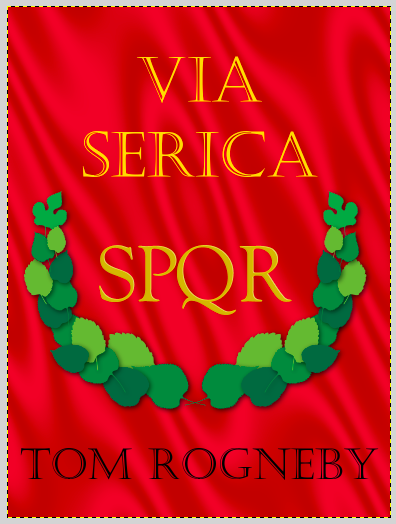
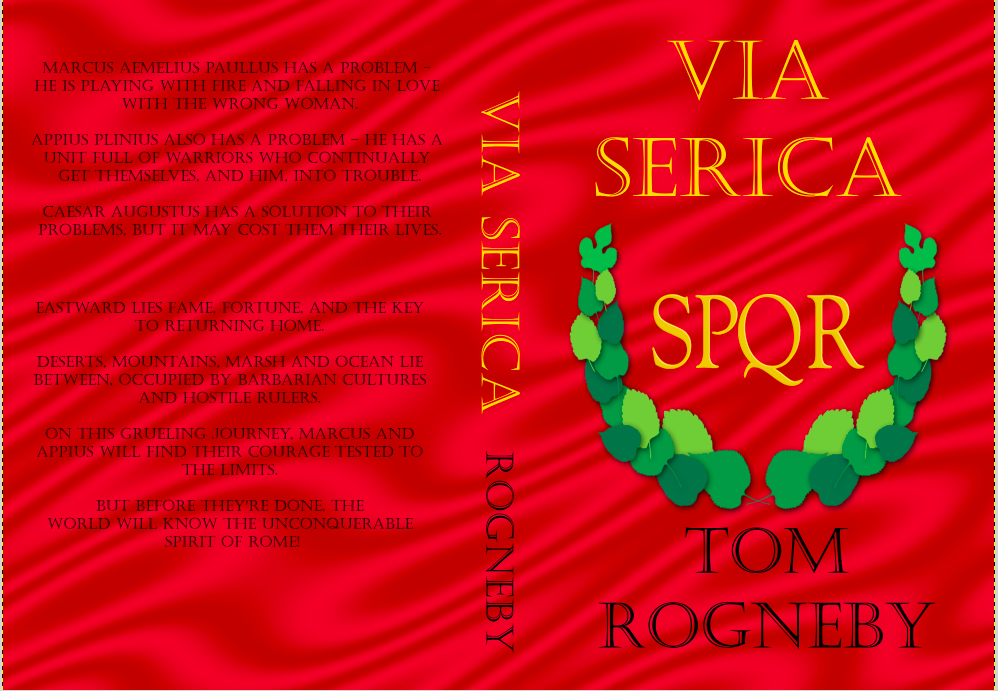
Here are screen grabs of the ebook and hard copy covers of Via Serica.

Screen Shot 2015-09-03 at 9.30.11 PM Screen Shot 2015-09-03 at 8.59.47 PM

Many thanks to Robb for the artistic talent and Wing for the back-cover blurb!

Snippet

This is a piece from “Via Serica,” which will be available in the next few weeks.  Please let me know what you think.


Eutropius approached the entrance to the Great Library. The high roof of its porch was bounded by tall columns, and its sides were lined with benches for the groups of teachers and students who sat in the shade to talk and debate. The building’s tall doors, made from some dark wood and decorated with bronze fittings, were carved with the symbols of the various gods and constellations.

As he gawked at the architecture and soaring columns of its entrance, Eutropius was jostled by clerks and older men who were coming in and out of the huge building.  After a few moments, he stopped turning this way and that, and started to walk into the library.

A big man with a bushy beard stopped him with a hand to his chest as he started to cross the threshold. He wore a green linen tunic and a sword hung from his belt. A bronze badge of some office or another hung from his neck, and he glared at the little slave from under dark eyebrows.

“What you do?” he asked in a loud voice, his Greek slushy in a thick accent that grated on Eutropius’ ears.

“I’m going into the library,” Eutropius said, holding out the paper that Actis had given him when he left the palace.

The guard took the paper out of his hands and squinted at it. He turned it over a couple of times, then ran his fat finger over the wax seal at the bottom. A broad, gapped smile of yellow teeth split his beard as he handed the paper back to Eutropius.

“Oh, prefect men always go in,” he said, sweeping his sword arm toward the door.

Eutropius squeaked a “Thank you” to the guard and scurried through the tall double doors of the library. Once inside, he stopped and gawked once again. Shelf upon shelf of books, scrolls, and tables stretched from floor to ceiling. Men and women walked among the shelves, some retrieving materials, some putting them back.

Looking around as he entered, Eutropius was amazed at the high domed ceiling. Beams of sunlight from its windows streamed down to illuminate the library, and as he watched, several birds flew through the sunbeams, casting shadows on the floor.

Eutropius began to walk deeper into the building. The smell of wax, ink, and papyrus was almost intoxicating to him, and he wondered where he ought to begin. There seemed to be no sign of how things were organized.

“I could spend a lifetime here looking for master’s maps, and I wouldn’t complain at all,” he said aloud.

As he wandered, he came upon a desk with several clerks behind it. One of them was in a heated argument with a man wearing a silk tunic and cloak. Both of them were waving their arms and shouting at one another in a language that Eutropius couldn’t understand.

Another clerk was speaking to an old man who apparently did not hear very well.

“No,” shouted the clerk, with an edge of irritation in his voice, “we have not received the books on the new tax laws yet. Check back in a few weeks.”

Eutropius considered asking a clerk where to look, but after a few minutes of waiting for one to finish a task and notice him, he drifted back toward the shelves. One of the clerks looked up from the scroll he had been packing for shipment, and watched the Greek randomly pick a corridor between the stacks of books, then turn to walk down it. The clerk stepped out from behind the desk and followed him.

Eutropius jumped when the clerk came up behind him and said in a loud voice, “What are you doing here?”

Eutropius turned around and faced the clerk, who was looking down at him imperiously. “My master has sent me here to find maps and do research on the lands beyond Egypt,” he explained.

“We don’t allow just any bumpkin with a sense of curiosity to just walk in here. How did you get past the guard?” the clerk demanded in a smooth, educated accent. Eutropius was immediately reminded of the snotty slave from Rhodes that had taught him as a child. Daily reminders of how his speech made him sound like something that had just fallen out of the dung cart on an olive plantation had not endeared him to such people.

The little scribe set his jaw and muttered, “I am no bumpkin, you officious dicktwister!”

The clerk’s head rocked back as if he’d been struck, then his face reddened as he began to shout, “Who do you think you are, you little shit? This is the Library! You can’t talk to me like that!”

Eutropius set his hands on his hips and leaned forward, returning the shouts of the clerk, “I am here on the orders of Senator Marcus Aemilius Paullus, who is on a personal mission of Caesar Augustus, you arrogant ox fucker! If you want to insult me rather than assist, then I will take this letter of introduction back to the prefect and let HIM deal with a librarian who can’t stand the idea of someone actually using his precious library!”

The clerk opened his mouth to spew a response, but stopped before the first word could come out. His red face slowly drained of color, becoming paler than it had been. Finally, he closed his mouth and looked around at the people staring at the two men.

“The prefect?” he finally said, leaning close so that he could speak quietly, “You’re here on government business?”

“Of course I am, fool,” replied Eutropius in an equally quiet voice, “Do you think I came to this warehouse because I like the smell of rancid wax and old ink?” To himself, he thought, And even if I do, it’s none of his business. I wonder who I have to kill to get his job?

Eutropius opened his clenched fist and held out the now-crumpled letter. The clerk took it and read it quickly, glancing at the wax seal at the bottom.

“I showed that to the guard at the door, and he said everything was in order,” said Eutropius haughtily.

The taller man looked up from the paper, and put on a false smile.

“I believe I know where the confusion lies,” he said, showing his teeth and trying to defuse the situation, “You spoke to the man at the door, the big Gaul?”

“Yes, the one with the beard,” replied Eutropius.

The clerk snorted. “That oaf can’t read. He probably saw the prefect’s seal and sent you along. You really should have shown this to one of us as soon as you came in,” he said.

“If you want to see my papers when I enter your shrine to the gods of dry rot, then you should post yourself at the entrance instead of ambushing me after I start going about my business,” snapped Eutropius, “Do you insult everyone who comes in here, or is that just a special service you provide to fellow Greeks?”

“My apologies for my tone,” said the librarian, “I only get like that with people who come here to steal or waste my time. We are driven to distraction by the curious and the thieves.”

“Well, I am neither,” Eutropius replied in his most theatrically haughty tone.

The clerk sighed and handed back the letter. “How may I assist you? You mentioned maps?”

Eutropius relaxed and smiled. “Yes, I need to know about the lands beyond Egypt. And yes, I especially need maps,” he said, looking around the library again, “How do you keep things straight in this labyrinth?”

“Oh, you learn how to find things. I’ve been here for about 10 years, and I’m still figuring things out,” replied the clerk, “May I ask why you need these? Is this curiosity on the part of your master, or practical?”

“Practical, I’m afraid. He and another senator are being sent on an expedition for Caesar. I can’t say exactly why,” replied Eutropius.

The clerk’s eyebrows went up and he let out his breath in a low whistle. He turned to lead Eutropius deeper into the library, “That shouldn’t be difficult. We have maps from the ports along the coast of the continent. If I recall correctly, they do not show much detail in the interior, but we shall see what we can find. When do your masters leave?”

“We only have a few days, so we will need to be quick,” replied Eutropius, hurrying to follow the clerk.

“Well, then, let’s get to it,” said the clerk, “There is much to see. You know, if you were to write down what you see as you go, it would make a wonderful addition to our collection.”

Eutropius thought to himself while he followed the clerk between shelves of rolled-up maps, I have to get there and survive to return first.

Snippet

Here’s a little bit of something that I’m working on now that Via Serica is almost done.  Let me know what you think.

December 18

Southeastern Arizona

Lupita threw the dirty diaper under a creosote bush and rubbed her hands in the sandy soil to clean them. Tomaso, the guide her husband had paid to guide them across the border, had called a halt to rest in an arroyo, and she had taken the opportunity to give the children something to eat and to change the baby.  There was no moon to light the cold desert night, but the clear sky was lit up with millions of stars, and she could make out the faces of the twenty or so other people who were making the journey north.  They were bunched up in small groups, mainly families, but several contained the single men who were making the journey to seek work.

Juan, her brother-in-law, passed over a container of water, which she brought to her lips with a murmured thanks.  Tomaso had told them to keep quiet, especially the children, and every time the baby had whimpered, he had hissed at her to shut him up.

“How much longer?” she whispered to Juan.  He had made the trip several times before, and was the one who had convinced her husband that she and the little ones could make the journey to join him at his job in Arkansas.

“We’re over the border,” he answered, “It’s a few more hours into the mountains, then we’ll rest for the day.  Tomorrow night, we’ll be in Tucson, then onto a bus for the rest of the trip.”

“Thank the Virgin Mother,” Lupita said, crossing herself.  The weariness of walking across the wide valley in fits and starts, all while making sure she didn’t lose one of the children, was taking its toll on her.  She looked to the north and saw the bulk of the mountains blocking out the stars.  Even though the thin mountain air was chilly in the December night, Lupita felt hot under a thin coating of sweat that ran down between her shoulder blades and down her chest.  The baby was heavy, and the work it took to keep the other two children moving fast enough to not get left behind was draining her.

Up into those?, she thought, picking the baby up and offering it her breast, You never said anything about mountains.  She leaned back against a rock and closed her eyes for a few moments as she felt the infant start to suckle.

Tomaso stood up and looked to the south.  Juan followed his gaze down the path they had followed up from the border, but saw nothing.  After a few moments, Tomaso shook his head and hissed, “OK, let’s get moving.  Keep quiet, for God’s sake!”  He watched as his charges got up and started straggling back into line, then started off toward the mountains.

Lupita took up the nylon cord she and Juan had tied around the children’s middles and started walking.  Little Carlos took his sister by the hand as they followed their mother up the slope of the first hills.

The incline got gradually steeper as the line of migrants straggled along in the dim starlight, and Lupita and her children were soon the last in the column again.  Even Juan left them a few yards behind as they climbed into the rolling foothills of the Chiricahuas.

Every so often, Lupita thought she could hear a clink or the heavy fall of a foot tripping over a rock behind her, but when she paused to gaze back down the path, she could see nothing.  Every time, she would shrug, give the rope connecting her to little Carlos a tug, and continue trudging uphill.

Finally, they crested the first ridge of the mountains, and Tomaso led them down into a small valley with stunted trees and bushes.  The big man wiped sweat from his face with the back of his hat and told them to rest for a while.  Lupita almost fell to her knees as the rest of the group stopped to rest, and little Carlos lay down and fell immediately to sleep next to her.  Little Sofia stood next to her, her thumb firmly planted in her mouth.  Lupita took her hand from the sleeping form of the infant and ran it down her daughter’s long, dark hair.

“Just a little further tonight,” she whispered in soothing voice, “then we can stop and rest.”  The little girl just nodded and continued to suck her thumb.

From up the hill they had just descended, she heard a series of clinks, then she thought she saw dim green lights bobbing in the darkness.  Juan heard it too, and hissed to Tomaso.  The guide stood up, drawing the pistol he carried in a holster on his wide leather belt.

“Who’s that?” he demanded loudly, pulling back the hammer on the big revolver.

Lupita clasped her children to her breast and turned her back as she heard several metallic clicks coming from the hillside.

Snippet

Looking for some opinions here.   This is a snippet from something I’ve been working on.  Let me know what you all think, and any suggestions or corrections are appreciated.

——————————————————————–

Appius Plinius stood in the small courtyard of the barracks complex.  The alternating pieces of iron and bronze that made up his lorica squamata scale mail winked in the late afternoon sunlight, which was streaming through the open gateways and doors leading to the barracks, stables, and storehouses that made up the small camp outside of Alexandria.  Under his left arm he carried his helmet, its scratched surface polished to a high gleam by his servant that morning.  Under his right hand he gripped the pommel to his long Gallic sword, which he never let get to the point that it needed polishing.   He unconsciously ran that hand through the short reddish-brown hair on his head.  It was this characteristic that had given him the nickname of “Rufus”, or “Redhead” among his fellow officers.  His men, however, didn’t dare to use it to his face, although it was occasionally used when he could hear it.  Some commanders might have dressed down a soldier for such familiarity, but so long as discipline was maintained, Appius figured he had better things to worry about. He was beginning to sweat through the cloth of the tunic he wore under his armor, but he disregarded this discomfort as he went over what he was going to do and say in the next few minutes.

Appius stiffened and saluted as his commander, Publius Aurelius Marcianis, legate of the Third Cyrenean Legion, walked into the courtyard.  The decorative scales of his lorica plumata armor had been intricately carved to resemble feathers, making him resemble a red-faced, bronze chested, rotund bird.   Appius had served with him for more than a decade, and knew that under the seemingly soft exterior of the senior officer lay a heart as dark and hard as any that could be found in service to the Republic.  He also knew that, while his decisions were well-considered and informed, he would have more luck trying to chop down the obelisk that stood outside of the camp’s gates than in getting Publius to change his mind.

“Hell, I’ve got to try,” he thought to himself as the legate returned his salute and waved him over to a pair of stools in the shade.

“Sir, about Cavarus.” he said, taking a seat after Publius had heaved himself down.

“Save it, Appius.  I didn’t get into this pretty armor or ride out here so that we could make a deal.  The answer is no.  What’s done is done, and your man will have to pay for what he’s done.”  said Publius, pulling his armor away from his tunic in a vane attempt to cool off.

“Sir, is there any way I can handle this myself?  I can demote him, or take away his pay.  Hell, I can assign him the extra task of cleaning the stables for as long as you want.” asked Appius, his mind racing to find an alternative.

“Appius, you know I hate doing this.  I’ve always let you try to keep discipline in your unit, but this is out of my hands.” answered Publius, “The young fool is the nephew of the prefect himself, and if this isn’t taken care of to his satisfaction, I will have Gaius Terranius breathing down my neck, possibly literally.  The best we can do is to get on with it, and try to keep things from getting out of hand.”

Appius sighed, and searched for something more to say. Seeing his discomfort, Publius put his hand on the other’s shoulder.

“Appius, this would be easier if this were the first time either this trooper or the whole unit hadn’t done something that was brought to my attention.” he said gently, “I prefer to let my commanders take care of things in-house, you know that.  But there comes a time when I have to act like a commander, and there also comes a time when a wound is lanced and a festering arm is removed.”

Appius looked up in surprise.  “Removed?” he said in a sharper tone.

“No one is going to take away your command, don’t worry about that.  I’ve always been impressed by you, both here in Egypt, as well as in Gaul.   It’s just that for the past few years, your men seem to have become harder to lead and control when they’re not charging after someone or out on patrol in this confounded desert.” Publius said sadly, “And to be honest, I’m getting tired of having to deal with complaints when a bunch of drunken Thracian auxiliaries burn down a brothel because they’re unsatisfied with the service.  I’m especially tired of having to send someone out here every so often to make sure that my best horse hasn’t been stolen again.

“But, I have a way to fix both our problems.  You and your men need something to occupy your time, and I need a way to get you out of my, and more importantly, the Prefect’s hair, and I think I have just the solution,” he continued, “I’ve been tasked with something that provides an opportunity to get your unit out of garrison for a very long time, which might be a good opportunity to get everyone, you, your men, me, and the prefect, back on track.”

Appius looked at his commander quizzically, “Sir,” he said, “we will, of course serve wherever you send us.  What is this ‘opportunity’?”

“We’ll discuss that after this unpleasantness is over, my boy.” answered Publius, raising himself up off the stool.  Appius rose as well.  “Come to see me tomorrow evening at my house.  We can discuss it over dinner.”

“Come, let’s get on with it.” said Publius, turning toward the passageway to the parade field.  A slave waited for him, and handed the legate his ornate helmet.  As they stepped out into the harsh Egyptian sunlight, his armor and helmet gleamed.  Next to him, Appius looked positively dull, even though his armor had been polished just that morning.  Publius stepped off at a quick pace, and Appius fell in on his left, matching his stride and rhythm.

At the far end of the field, standing in three ranks, stood Appius’s men.  Their ring mail shirts, over tunics of Egyptian linen, would never gleam, but Appius’s trained eye could see that it had at least been kept clean and mended.  Their peaked helmets glinted dully in the sun, and their oval shields stood to their sides. As Appius and Publius drew nearer, the short gladius on each man’s left hip could be seen.  Shorter than the sword their commander had taken to carrying, it was a perfect weapon for closing in with a foe and tearing at his belly or neck.  All eyes were straight forward, although years of getting to know his men told Appius that a tense anger was sweeping through the ranks. Under his breath, Appius said a short prayer asking for calm in the next few minutes, or else Publius might have occasion to break out a truly harsh punishment against them all.

The hawk-like symbol of Horus had been freshly painted upon their shields, mimicking the gold and red standard that hung from a spear in front of them.  Terus, the detachment’s vexilarius, or standard-bearer, stood stiffly at attention in front of the formation, holding the standard perfectly straight.   Next to him, also standing at attention, stood Lucius Turranius Gratianus, military tribune of the Third Legion and aide to Publius.  He wore armor similar to that of the legate, although his helmet had been engraved with crossed swords and charging stallions, where Publius had an eagle engraved on each side of his.  A dark red stripe ran along the bottom of the linen tunic that flowed out from under his armor, denoting his status as an elected military tribune, the first step on the political ladder of the cursus honorem.  As he saw Publius and Appius approaching, he opened his mouth to shout a command, but was cut off as Cotys, Appius’s second in command, bawled out “Attention!”  The men did not move, as they had already drawn themselves up, but Gratianus’s face grew a deeper red than before, which almost hid the purple bruise over his left eye.

Publius stopped a few paces in front of the tribune and the standard bearer, while Appius marched to stand next to his standard.  He faced about, then raised his hand in salute and shouted “Sir, my unit is assembled as ordered!”.

Publius returned the salute, then took a moment to look down the long line of grim soldiers facing him.   After surveying the veterans and taking stock of their equipment and attitude, he called out “Bring him forward!”

Two legionaries, dressed in full battle armor, but lacking their rectangular shields and pilum, marched out from behind the formation.  Their armor was similar to that of the assembled cavalrymen, but the their tunics were dyed blood red, and their helmets were standard issue, while the Thracian auxiliaries’ were shaped into a peak in the manner of their homeland.  Each held an arm of a third man, dressed only in a plain robe, with his hands tied in front of him with leather thongs.  The prisoner marched in step with the legionaries, his head held high, and neither fought the hold on his arms, nor allowed himself to be pulled along. The trio marched to the front of the formation, stopping and coming to attention in front of Publius.

Publius leveled his gaze on the prisoner.  “Cavalryman Cavarus, Thracian auxiliary of the Third Cyrenean Legion, you are guilty of being drunk in the barracks, disobeying the order of one of the legion’s tribunes, and of assaulting that tribune when challenged for your behavior.  Since this is the third time I have chastised you for your conduct, you shall be punished accordingly.” he called out loud enough that the third rank of the detachment could hear him.

Appius heard the men draw in a sharp breath at that last sentence.  He fought an urge to turn his head and look at his men, but kept an ear open for the sound of sandles shifting in the pebbles and sand of the field.  “Mars, father of battle, please keep my men calm.  If you do this for me, I shall sacrifice a ram to you before the dawn breaks tomorrow.” he prayed silently.

“You shall be given ten lashes, and will forfeit a month’s pay for your crimes.  Should you transgress again, I will not be as merciful.” said Publius.

Appius let out a breath he had not even known he was holding, and he heard the men behind him do the same.  His worst fear would have been that Cavalus would have been sentenced to death, probably by being beaten to death by the other men of the detachment.  “Mars, thank you.  At least I won’t be trying to control a riot this afternoon.” he silently prayed.

At a nod from Publius, the legionaries marched Cavarus to a post which had been set in the  ground to the side of the formation.  Taking out their daggers, they cut the robe off of Cavarus, leaving him naked.  The taller of the legionaries took Cavarus’ hands and tied them to a ring atop the post.  Both legionaries took whips from their belts as they stepped a few paces back and to the side of the bound cavalryman.

Publius turned to face Cavarus and his captors.  After a moment, he called out “Decurion Appius Plinius, call the count!”

Appius took a deep breath, and shouted “One!”

The tall legionary swung his arm back, then brought it forward.  The tail of the whip smacked against the skin of Cavarus’ upper back, leaving a red streak as it broke the skin.

“Two!”

The second legionaries arm was already cocked back, and at Appius’ shout, came forward in a fast movement.  His stroke crossed the mark of the first, causing Cavarus to convulse in pain.

“Three!”

The tall legionary shot his arm forward again, placing a new mark a few inches below and parallel to the first.  Cavarus shuddered again, but no moans or shrieks came from him.

“Four!

Crack

“Five!”

Smack

“Six!”

As the third pair of red marks on his back was completed, Cavarus’ legs went out from under him.  He hung by the wrists, the leather thongs pulling cruelly at his skin.

“Seven!”

The tall legionary adjusted his aim, bringing his lash down across the back of Cavarus’ thighs.  Cavarus twitched at the touch of the leather whip as it striped his legs in blood.

“Eight!”

Crack

“Nine!”

Smack

“Ten!”

The last lash cut down across Cavarus’ prostrate form.  He was not moving, but Appius could see him taking breaths as he twisted on the post.  Publius nodded at the legionaries, and the only sound that could be heard by anyone for several minutes was that of pebbles grinding under their boots as they marched back to the barracks.

Publius turned back toward the assembled cavalrymen.   Again, he surveyed the faces of the men, noting that they continued to stare straight forward.  “Men, soldiers, comrades, we can all learn lessons from Cavalryman Cavarus.  As soldiers, we should learn to maintain our discipline, lest we suffer his fate.” he said, his voice carrying across the formation.  “As men,” he continued, his eyes settling on the military tribune, who stared at Cavarus with a look of horror on his face, “we should learn to take our lumps without complaint, even as he did when the lash cut him.”

“Decorion, take command of your detachment.” Publius said.  Appius raised his arm again in salute, which Publius again returned.  Publius turned on his heel, and marched back to the barracks.  Tribune Gratianus fell in on the right of the legate.  Appius’ eyes followed the back of the tribune’s head, and he noted that the skin on his neck grew a darker and darker red as he moved away. He also noted that the young officer did not fall into the same marching cadence as that of his commander.  Appius suppressed a snort of derision at the young amateur.

Appius waited until the two men went through the portal that he and Publius had emerged from, then stepped forward to the place that Publius had occupied.  He turned on his heel, facing his men.  “Cavalrymen Cotys, lead the men to the barracks, and confine them there until I join you.  Vexilarius Tereus, stay here with me.”

Cotys turned his head toward the rest of the formation, and shouted out “Right, face!”  Each trooper lifted his shield a hands breadth from the ground, and pivoted on his right foot.  All thirty men brought their left foot forward and down at once, and the crash of their armor and booted feet echoed from the front of the barracks.

Cotys again turned his head and shouted “Forward, march!”, and each man stepped off on his right foot.  Cotys led them toward the barracks, and Appius was glad to see that he had the presence of mind to take them the long way to the back gate.  That would allow the legion’s legate and tribune to ride away with their guard detachment before his Thracians got there without him.

“Tereus, come with me.” Appius said quietly as he walked over to Cavarus.  The man had twisted over onto his side, and was supporting some of his weight on his knees.  Appius saw his chest rise and fall as he approached him, but the man’s open eyes did not see his commander and standard bearer as they walked up to him.

“Cut him down, Tereus.” Appius ordered as he removed his red cloak.  Tereus drew his dagger from the scabbard on his belt, and sliced through the leather thongs that held Cavarus to the top of the post.  The man dropped instantly, but Appius caught him before he flopped onto the ground.  Supporting Cavarus’ weight with one hand, he gently wrapped the cloak around the stricken cavalryman.  Tereus put up his dagger, then helped Appius lift Cavarus to his feet.  Cavarus was shivering as if he were cold, and his mouth worked as if he wanted to speak, but no sound came from him.

“Let’s get him back to the barracks.” Appius said as he stood up.  He pulled one of Cavarus’ arms across his shoulders, and Tereus took the other.  Cradling the standard in his other arm, Tereus said “That little whinging bastard left out of here, crying and blowing snot.  If he’d been any kind of man, he would have…”

Appius cut him off sharply, “Quiet.  Let me deal with the tribunus laticalvius.  Let’s deal with your brother, first.”

Together, the two men half carried, half drug their comrade back to the barracks.  Cotys met them at the door, and took Cavarus’ arm from Appius.

“Take him in and clean him up.  Keep the men inside until I say otherwise.  I’ll be back as soon as I can.” said Appius, turning to go without waiting for Cotys to acknowledge the order.  Appius walked through the gate to the camp, nodding curtly to the guards as he went through it and down the road to the village that had grown up outside it.

An hour later, just as the sun was beginning to set, Appius returned.  In his wake, a middle-aged man, wearing a tunic cut in the Greek style, and a small boy, bearing a bag on his back, tried to keep up with his brisk strides as best they could.  Appius walked up to the door to the detachment’s area of the barracks, and stepped inside.  His eyes quickly adjusted to the gloom, and he took a look around the open space of the barracks.

It was a converted stable, which some Roman officer had decided fitting for a detachment of auxiliary cavalry.  Appius had kicked up a storm over that, but his men had made the most of it, scrubbing down every square foot and constructing beds out of the wood from the stalls.   Each file had their own small area, while Appius had been given a small room at the far end of the hall.  Cotys had tried to have the men build it next to the door, but Appius had overridden him.  He liked to walk through the men’s quarters to get to his own, and that gave him an excuse to see how they lived, and to catch any that tried to push his luck with the regulations and Appius’ commands.

Seeing him and his two companions come in, Mostis, leader of his third file, called out, a little too loudly, “Attention!”

Appius ignored what was obviously meant to be a warning to the other men in the barracks, and walked to the cluster of beds used by the first file of the detachment.  Cotys was standing at the foot of Cavarus’ bed, while Tereus was giving sips from a mug to Cavarus.  The soldier was laying on his side.  His friends had washed him, but his wounds continued to weep blood onto the blankets underneath him.

Appius looked at the doctor, who had caught up with him when he paused at the door, and nodded. The man leaned over Cavarus and clucked his tongue.  “They did a good job on him, didn’t they?  That’s all right, we’ll fix him up.  Ajax, let’s get to work.”  he said, pointing to the boy, who unslung the bag and began to take pouches, vials, and bottles out of it.  Looking at Appius, he said “I will need better light, if that’s possible.”  Cotys took flint and steel from his belt pouch, and lit one of the lamps that hung from the rafters.

As Appius and the other cavalrymen watched, the doctor took the mug of wine from Tereus.  He opened one of the pouches, and shook out what looked to Appius to be dust mixed with herbs into it.  Using his finger, he stirred the mixture into a loose paste.  He then dabbed this onto the wounds on Cavarus’ back.  Cavarus again shook with the pain, but made no sound.

“It will sting a bit now, but this will ease your pain soon, and it will stop the wounds from festering.” said the doctor in a soothing tone.  Looking up at Tereus, who had not left his brother’s side, he asked “Will he want the scars from this to fade?”

Tereus thought for a moment, then said simply, “No, he will want others to see.”

The doctor nodded, then selected a vial from the collection the boy had unpacked.  Pouring it onto a cloth from the bag, he dabbed a purple liquid over the whole of Cavarus’ back and legs.  Taking a bundle of herbs from the boy, he lit them with the flame of the lamp, then blew their pungent smoke across Cavarus from head to toe.  The bitter odor of the smoke made Appius’s eyes water, but they seemed to have no effect on the doctor.

As he finished and stood up, he patted Cavarus gently on the shoulder.  Taking another pouch from the boy, he handed it to Tereus and said, “He will be able to get up by morning, but make sure he mixes a third of these herbs into his wine every morning until they are gone.  It will ease the pain a bit.” he said.

Tereus took the pouch with a nod of thanks, then returned to sit next to his brother’s bed.  The doctor gestured at his apprentice, who began to put away the medicines.  The doctor walked up to Appius and put out his hand.  Appius placed a pouch into it, and the coins it contained jingled as the doctor weighed them in his palm.  A smile came across his face, and the doctor bowed his head at Appius.

“Thank you, sir.  I shall sacrifice a pair of doves to Asclepius for you tomorrow morning, in thanks for the healing of your man.” he said.

“Thank you, physician.  Is there anything else to be done?”  asked Appius.

“No, he will heal with time.” said the doctor, “May we go?”

Appius pointed to one of the cavalrymen who had clustered around.  “Zisemis, escort the doctor and his apprentice back to their home.  Return immediately, Zisemis.  There will be no drinking or whoring for anyone tonight.” he ordered.  Zisemis nodded, and hurried off with the doctor and the boy in tow.

Appius looked around the room.  The entire detachment was gathered around to watch the doctor’s work, and now their eyes bored into him.  A casual observer might have thought that the Roman was an outsider to the Thracians, but years of hard patrols and fighting, along with Appius shielding them from the worst when their behavior off duty had gotten out of hand, had bonded him to them.

“Sir, Cavarus didn’t deserve this.” said one of the troopers, his dark eyes reflecting the flame of the lamp.

“No, all of you deserve it.” said Appius, “He was left alone, drunk, in the barracks.  None of you stayed behind from your quest to drink all the wine in Egypt and sleep with every whore in Alexandria.  When the tribune came looking for me, there was nobody but him for that officer to talk to, and nobody to stop Cavarus before he punched him.

“All of you take a long look at what has happened to Cavarus, and think about what you could have done to prevent this.  I can’t protect you when you do something this stupid, and Cavarus is suffering because of it.”

Appius looked again at his men.  Most of them looked as if he has punched them in the gut, which matched how he felt after the day’s events.  After looking at each of them, Appius looked to his second in command.

“Cotys, nobody leaves this barracks tonight.  I want guards at the door, and a count taken every hour.” he ordered.   Cotys nodded, with a mumbled “Yes, sir.”

“And, Cotys, I want every swinging dick in this detachment on the parade field tomorrow in full battle armor.  No horses.  We’re going to get a little exercise.  Might be good for our souls.”

Appius spun on his heel and headed for the door.  Pausing to put on his helmet before walking through the portal, he looked back at his men.  “Now, if you all will excuse me,” he said, “I owe a ram to Mars.”

The War VI – Musings

I hope you all have enjoyed my thought experiment on Iran, Korea, and Syria over the past few days.  It’s something that’s been rumbling around in my knoggin for a couple of weeks.

I started with the question “How is Iran, after all these years of economic and diplomatic subterfuge, going to make her entrance into the club of nuclear weapon capable nations?”.  I assume that they will eventually do it, and my bones tell me it will be sooner rather than later.  My guess is that they will try to make as big a splash as they can, both for domestic and foreign audiences, so I went with an atmospheric test that could be seen from Tehran.

Of course, that led to the “How do they think they’ll get away with that?” question, which led me to the attacks on civilians in the continental United States.  We are an extremely open and trusting society, especially in suburbia, and if you were trying to knock an administration as sensitive to the domestic situation as this one is back on its heels, then striking at the soccer moms would work very well.

North Korea got mixed up in my scenario because of the reports that Iran is helping North Korea with its missile program, which is now believed to be capable of hitting the United States.  I assume that if you can put an object into orbit, you can either de-orbit it at will or just have the missile and payload do a ballistic arc to a target on the other side of the Pacific.  If Iran was to try to sucker punch us so that we wouldn’t respond to a nuclear test, then I don’t think it’s too hard of a stretch that they’d try to get the North Koreans to make a demonstration that would show that a response to Iran would have dire consequences to us.

I had the North Korean bomb go off over the South Pacific because I didn’t want to get into the debate on the feasibility of a “One Second After” scenario if it went off over the United States or Europe.  Something going off above the ocean to the east of New Zealand would cause a lot of damage, but not so much that I’d have had to write a “We lost the eastern seaboard” scenario.  It’s also where the North Korean satellite was orbiting the day I wrote that section.

As for the reaction of the United States, it took me a long time to decide how the administration would probably react to nuclear detonations on the part of Iran and North Korea.  Would President Obama lash out emotionally and immediately rain nuclear warheads down on both countries?  Would he try to cut a deal that headed off a conflict and basically shrugged our collective shoulders at the situation?  In the end, I decided that he would try to allow diplomatic means to work, but in the end he would bow to pressure and ask for a declaration of war.

How we dealt with North Korea would be, to me, about right for response to a nuclear attack and preparations for another.  How we dealt with Iran in my storyline is how my gut tells me Obama would do it.  Overwhelming force against someone who has used a nuclear weapon against us and our allies and is probably preparing to to it again is not a stretch for the president.  Using overwhelming force, either nuclear or conventional, against Iran, is outside his scope given the scenario I put forth.  While I won’t posit that the president wouldn’t react to the attacks against civilians, I don’t think he has it in him to get the country involved in another mid-East conflict, even if it were wholly justified.

The Syria/Israel thing was an outgrowth of my thought experiment on Iran.  How much havoc would it cause for the United States if Israel was retaliating with overwhelming force against Syrian attacks against its people with chemical weapons?  In my mind, Tehran may have been hoping that Egypt and other Arab states and possibly Turkey would get involved, ripping a huge hole in our mid-east foreign policy and war making ability.

As for the feasibility of our people being hit like that, I don’t think it’s that big a stretch of the imagination.  Like I said, we are an extremely open and trusting society.  Someone who comes here with an accent or a different color of skin is usually at least tolerated, if not welcomed.  An attentive family of middle eastern descent wouldn’t raise an eyebrow when they are picking up their kids after school or shopping at the mall.   I got the idea for how Hezbollah got its people into the country from something that Bryan Suits mentioned on his podcast, and it makes sense.  Hezbollah is indeed almost an arm of the Iranian government, and it is known to be active in Canada and  South America.    As much as people like to scream about how harsh our border policy is, the Mexican border isn’t that much more secure now than it was in 1995 when it was common to find debris and bodies out in the Arizona desert.  The operatives in my story line that came in via Canada are based on how open our country is to immigration.  Yes, legal immigration is difficult, but it can be done of you can get someone with a clean record and nothing but time, especially if they are a doctor or technology specialist.   Openness to immigration has always been a source of our strength, but it could also be used against us if someone thought in terms of years and decades.  Hiding a few thousand terrorists among the thousands of good people who have immigrated here since the early 1980’s wouldn’t be terribly difficult.

I also threw in something that’s been troubling me about our response to al Qaeda.  We’ve concentrated on securing infrastructure for over a decade, but have paid nothing much beyond lip service toward securing the lives of those who use that infrastructure.  Heck, large sections of the government and the media are doing their best to demonize those of us who believe that is our responsibility to provide our own security.   America is a huge, juicy target, and we are basically hanging out there waiting for someone to try again.  I don’t want a police state, but we have to recognize that  continually preparing to defend against another 9/11 is going to leave us eternally open to another Madrid, London, Bali, or Mumbai.  The FBI has made a habit out of enticing morons into trying a terrorist attack, but I haven’t heard anything about efforts to make sure that nation-state sponsored terrorists aren’t taking root here.   We’ve spent 12 years defending against cave-dwellers, but are we ready to deal with the threat that a sovereign nation bent on doing us ill represents?

The Home Guard that I included is something that I believe would be very easy to institute in the wake of both terrorist and nuclear attacks.  It’s been done before, with older men, women, and teenagers being used during both World Wars to watch beaches, railroads, and factories for saboteurs.  Rather than see the DHS run roughshod over local law enforcement to improve security, I could see the governors instituting such a program of volunteer guards to be speed bumps and trip wires in the event of further attacks.

This story was more “The Third World War” than it was “Team Yankee“.  Sorry, but I’ve never been good at characters and dialogue, so I stuck with what I can do.  Like I said, I hope you enjoyed it.  It definitely got some really dark thoughts out of my head.


Update – Drang has some excellent thoughts on unorganized militia.

The War: V – Aftermath

In the immediate aftermath of the Christmastime attacks, the population of the United States pretty much vapor locked.  No-one went shopping, no-one sent their kids to school, even if the schools were open, and for the most part, we stuck around our homes and watched the news for a few days.  Churches, on the other hand, were packed full, although with openly armed parishioners in front of more than a few of them.  Like I said, no-one reported retaliation against Muslims in the United States, but after the relative calm that occurred after 9/11, that wasn’t much of a surprise.

Of course, the economy took a hit, with a rather sharp recession hitting us that winter and spring.  The retail and service economies pretty much collapsed for a few quarters, which sent ripples back into transportation and manufacturing.  This caused the soft landing of the Chinese economy to turn into a crash.  The Communist regime had wisely stayed out of the war in Korea, but the sudden drop of demand in its largest export market sent shock waves through their overheated economy.   There was unrest, most of which was put down quite violently by the PLA, and the Chinese government almost fell in a military coup about a year into the war.  Since then, they’ve slowly built back up, with more focus on their domestic market, and as our economy slowly recovered, so did theirs.

Like China, Russia pretty much stayed out of the war.  There have been a few incidents in Moscow and St. Petersburg, and the Chechen war has flared up again, but that bleeding sore would have been there no matter what.

In other words, Iran pretty much stands alone, but they are a tough nut to crack if you’re not willing to use a hammer.  For one reason or another, the President chose to not utilize overwhelming force, nuclear weapons, or a ground invasion to deal with the Iranians.  It’s been a long war, and there’s no end in sight.

The morning after the declaration of war, we had something in America that hadn’t been seen since 1941 – long lines at military recruiters.  I, along with a lot of veterans, got my DD-214 and resume out of the safe and headed to the nearest recruiter to sign back up.  We were joined by a large number of young men and women who wanted to leave their colleges and jobs to serve.  Unfortunately for me, they weren’t looking for 41-year-old Russian linguists and computer nerds, so I was turned down, but a lot of younger veterans and those with more critical skills were accepted.  A lot of the first time enlistees had to be put on a waiting list to be sent to training, but it’s a credit to them that when they were called months or even years later, they almost all still volunteered.

China and South Korea are occupying what used to be North Korea, but we have been providing a lot of material and personnel support.  Even though the communist regime was pretty much gutted within days, a lot of people feared that what was left of the DPRK armed forces would attack the South.  Luckily, that didn’t happen.  Once Pyongyang and the top level of leadership were eliminated, most North Korean soldiers, including officers, just walked away.  I’ve read reports that some officers tried to hold their units together and fight, but those officers were outnumbered and short-lived.  There are occasional reports of communist forces coming down out of the mountains and shooting up a checkpoint or assassinating some official or another, but they are becoming rare.  Without support from China and with the North Korean people learning that it’s better to be fed than to live in a worker’s paradise, their numbers are dwindling.

Of course, our government didn’t let this crisis go to waste.  Even though a lot of the blame for the Christmastime attacks fell on the Department of Homeland Security, it got a big shot in the fiscal arm and has spread its reach a lot further into the nation.  The Border Patrol has become fully militarized, and the Mexican border zone has pretty much become a free fire zone.    Canada, for their part, has rounded up several hundred Hezbollah and Iranian agents, all of whom were extradited to the United States.  Those trials are still going on, and will probably stretch out for years.  There’s also a new “electronic fence” and a lot more in-person patrols going on along the Canadian border.

The Department of Education made a play to get its own security force to guard schools and such, but that was shut down by Congress after the state governors collectively agreed to form the Home Guard.  The Home Guard, distinct from the National Guard, is a collection of volunteers who keep watch over schools, busses, factories, and the like.  It’s composed mostly of veterans who didn’t, for one reason or another, go back in the military.  Most of its members do their duties armed in one form or another, although some states discourage that.  Kentucky, on the other hand, has no issue with us carrying whatever gun we choose to, so long as we carry a gun.  The Home Guard was formed in the months after the attacks, and was instrumental in thwarting the second wave, which struck on the six month anniversary of the Christmastime attacks.

The Iranians tried to catch lightning twice, but their second attempt pretty much fizzled.  The combination of increased security, a more aware population, and Home Guard units standing watch made sure that most of the people who tried to repeat the success of the December attacks met with a rather sticky end.  One woman, who made the mistake of hesitating as she walked up to a bus station before blowing herself and a bunch of students and their mothers apart was beaten to death and pretty much ripped limb from limb by the parents of the children she’d tried to murder.  No-one bothered the school bus I was riding on that day, but one bus in Louisville got shot up before its attackers were killed by LMPD and the Guardsman on the bus.  Luckily, only the Guardsman was hurt in the attack, with all of the children having learned their lessons during drills on what to do in the event of an attack.  The use of busses has greatly expanded in the years since the attacks, as most schools got rid of drop off and pick up on school grounds, and those that kept it made it an ordeal to get through security.  The home and community schooling movement has had a big shot in the arm from all this.  The number of children being educated by their families has skyrocketed.

The Assad regime collapsed under the weight of Israeli bombardment and rebel ground forces.  Once Assad himself had boarded a plane and headed to Tehran, the bloodbath began.  People who had either supported the regime or were members of groups that had supported the regime were hunted down and publicly executed.  Of course, once the government was gone and old scores were settled, the factions that had made up the “Free Syrian Army” turned on each other and fought over control of the country and the huge military stockpile that Assad left behind.  The civil war there has dragged on for years, but it looks like the worst of it is over now that the sides have bled each other white and the weapons depots are pretty much empty.

Once Syria was neutralized, Israel turned on Gaza and the West Bank.  Every block in Gaza that had a rocket launcher on it was leveled, but even Egypt has praised Israel for minimizing civilian casualties.  Hamas was gutted, with what survived of its leadership getting the heck out of Dodge just ahead of the Israeli army.  Unfortunately, the Israeli answer to what to do about the Arab populations of the West Bank and Gaza has pretty much amounted to ethnic cleansing.  With the memory of rocket bombardments that distracted them from countering chemical attacks against their civilians fresh in their minds, Tel Aviv had little compunction about telling the residents of these areas to get out and stay out.  The usual bleeding hearts at the U.N. and E.U. made noises about it, but the answer from the Israeli prime minister, given in front of a meeting of the U.N. General Assembly, boiled down to “go pound sand”. Israel still has to deal with regular terrorist attacks, and their relations with most of the E.U. are very tense, but they’re no worse off than they were a decade ago.

As for Iran, well, things haven’t gone as well for us.  After turning Natanz and other nuclear and command installations into rubble, the President called off the dogs.  With Syria in shambles, Israel ejecting hundreds of thousands of people, and the northern half of the Korean peninsula in flames, he didn’t want to commit resources for an invasion of Iran and continued bombing would have done no further needful damage.  Of course, Tehran crowed about facing down the Great Satan, and low-level terrorist activity against our forces throughout the mideast became a regular event, as did terrorism in the continental United States.

Their puppet government in Iraq protested the use of their airspace in the initial phase of the war, but once Iran was unable to provide them with much support, the government in Baghdad pretty much dried up and blew away.  I understand that a separatist movement in the Kurdish region is gaining momentum, and if Kurdistan leaves, then the rest of Iraq will probably shatter. The Kurds seem to be the only people actually following through on Iraq’s declaration of war against the Iranians, with regular raids and artillery duels across their border.  If I had to choose my allies in the region, they’d be much higher on my list than the southern Iraqis.

We’ve spent the last couple of years playing cat and mouse with the Iranians.  We make an air raid or night-time smash and grab against them, they send a group of suicide bombers against our soldiers or try to kill more of our civilians.  The new normal in the heartland is armed Guardsmen on the streets and citizens watching for the shopping bag that gets left behind or the mother wearing a coat that’s too big or too heavy for the weather.  The term “Balance of Terror” has been used more than once.

Right now, the President is holding out against making further commitments until after the election.  He says he doesn’t want to saddle the next person to hold the office with a battle plan he put together. My gut tells me he doesn’t want his party to lose political points because we’re bogged down in a land war in Central Asia during the election.  The President sent up a few trial balloons about putting off the 2016 elections due to the war and concerns about safety at polling places, but that was met with widespread howling.  His party didn’t do well in the mid-term elections, but the presidential election later this year is expected to be very close.  A war hasn’t changed the fact that almost half the electorate supports one party and most of the other half supports the other.

So there we are.  North Korea is slowly coming out of the dark ages, although it was and still is a bigger basket case than any of the Eastern European countries were after the fall of communism.  Our country is still strong, but has a lot more ‘security’ baked into its domestic cake.  Iranian forces have been sparring with our allies in Turkey, and there’s a possibility that a full-blown ground war will erupt along that front, but that remains to be seen.  The Turks probably wouldn’t need or ask for our help anyway.

It’s strange that the Third World War would be both so bloody minded and so long-lived.  If you’d asked me the day after the attacks if Tehran would still exist almost four years later, I would have asked if you were crazy.  Now, after a few weeks of heavy fighting and over three years of fancy footwork, I have no idea when the war will be over.  Girlie Bear will be commissioned into the Army Medical Corps soon, and her two older brothers are both in the service, one in the Navy, and one in the Air Force.  Who knows what the next few years will hold for them?